Local-first workspace intelligence
Atlas
v1.0.3 released · not in active development
Can an assistant answer from your workspace, and say so when it can't?
A Rust and Tauri 2 desktop app that indexes one codebase or document set and answers with inspectable evidence. Questions without enough workspace evidence can be declined instead of answered from general model knowledge.
- Role
- Personal project · MIT licensed
- Period
- Feb – Sep 2026
- Stack
- Rust · Tauri 2 · React 19 · TypeScript · Ollama · OpenRouter (opt-in)
- Question
- Semantic and BM25 candidates
- Reciprocal-rank fusion
- Relevance check, or decline for lack of evidence
- Bounded evidence → answer with inspectable sources
One loop, on purpose
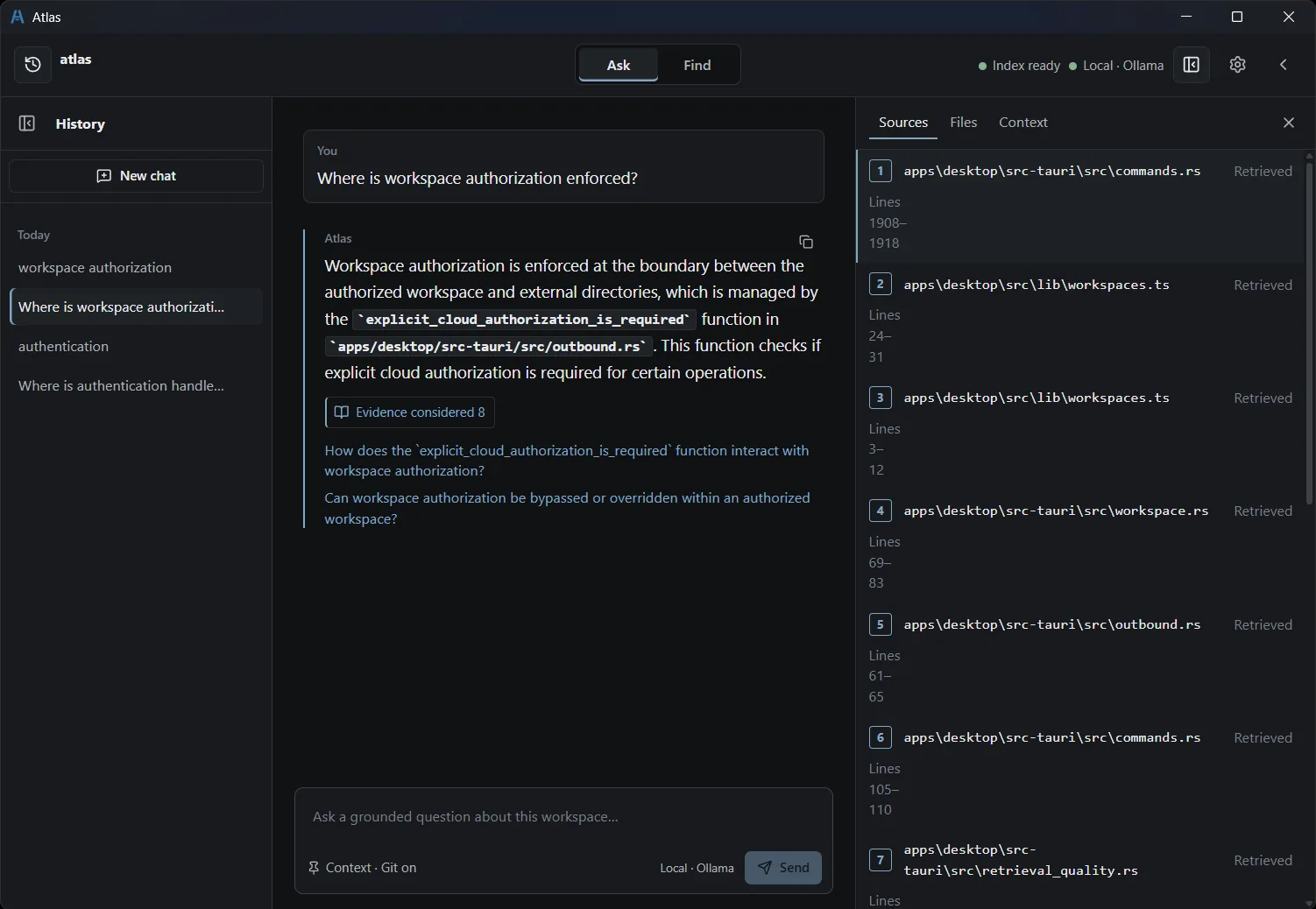
Earlier builds of Atlas reached for more surfaces. For 1.0 the product was narrowed to a single loop: open a workspace, index it, ask or find, inspect the evidence, follow up. Agents, arbitrary shell execution, personas, graph surfaces, web search and vision attachments are not part of 1.0.
Retrieval
Workspace files are chunked and embedded locally through Ollama. A question gathers semantic candidates and BM25 candidates, fuses them with reciprocal-rank fusion, classifies them for relevance, removes duplicates and selects a bounded evidence set for the model.
Indexing is incremental, and a damaged generated index can be detected and rebuilt without touching the source files.
Saying it doesn't know
When a question has no adequate evidence in the workspace, Atlas can decline it rather than answer from general model knowledge. The evidence it shows is the material supplied to or considered for an answer, not sentence-level attribution, and the app says so.
An explicit cloud boundary
With local Ollama, indexing, embeddings, generation and evidence stay on the machine. OpenRouter is optional and has to be enabled explicitly; a request that has not authorised it is blocked.
When it is enabled, the query, retrieved evidence, pinned context, relevant history and any enabled Git or system context may be sent. Before anything leaves, Atlas assembles the complete bounded payload and Secret Shield scans it for known secret formats such as AWS keys, GitHub tokens and API keys. A match blocks the request. The OpenRouter key is held by the Rust side in the operating system's credential store.
Limits
- Windows x64 only. The installer is unsigned, so SmartScreen shows an Unknown Publisher warning; the release publishes a SHA-256 checksum.
- The updater is disabled. Linux is configured but unverified, and macOS is unsupported.
- PDF and generic-file chunking is basic, relevance calibration is heuristic and context budgeting is approximate.
- Secret Shield matches known patterns. It is a safety net for the cloud path, not a guarantee.